92252
Joshua Tree Desert Modern
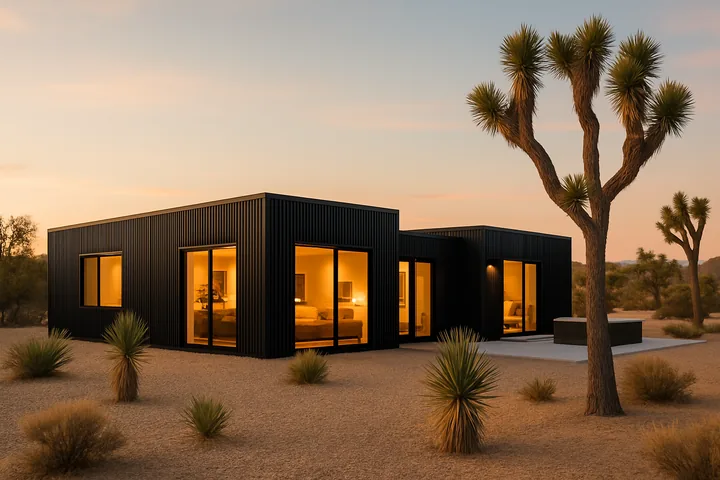
Value
$685K
Est. savings
$72K
2BR · STR · 2yr owned
Most Joshua Tree short-term rental owners can reduce taxable income by 20–35% using cost segregation and the STR tax loophole. Find out in 30 seconds.
Cost seg pays on your Joshua Tree STR when three conditions hold. You run it as a short-term rental. You materially participate — 100+ hours per year, more than anyone else involved. And you have W-2 or business income to absorb the deductions. Year-one federal tax savings on qualified Joshua Tree STRs typically land in the $20K–$180K range. + California state (13.3% top bracket) The 5-question calculator below tells you what your specific number looks like.
Adjust the inputs, then click See my verdict.
Modeled from Cost Seg Smart's recent Joshua Tree-area engagements (Morongo Basin · San Bernardino County), aligned to the 2026 Cost Seg Smart benchmarks dataset (n=260 studies across 13 property types).
We'd rather lose your business than sell you a study you don't need. If any of these match you, reconsider.
Modeled scenarios across Joshua Tree submarkets — not specific customers. Actual studies will vary by finish, age, and owner participation.
It usually is, when the property runs as an STR, you materially participate, and you have W-2 or business income to absorb the deductions. Year-one federal tax savings on qualified Joshua Tree STRs typically land in the $20K–$180K range. The calculator above gives you the exact number for your specific inputs.
Properties with average guest stays under 7 days are not treated as rental real estate under Treas. Reg. §1.469-1T(e)(3)(ii). With material participation (IRC §469(h) — 100+ hours/year, more than anyone else), the resulting losses are non-passive and can offset W-2 or business income. This is what makes cost segregation powerful for Joshua Tree Airbnb owners.
Three things: (1) less restrictive STR regulation than Palm Springs — Joshua Tree is unincorporated San Bernardino County, so most properties operate under county rules rather than city ordinances, though a 12% TOT applies; (2) unusually high FF&E density — hi-desert vacation rentals typically feature hot tubs, fire pits, outdoor showers, and custom landscaping, pushing reclass ratios to 28–34%; (3) California state income tax stacks with federal, meaningfully amplifying cash benefit per dollar of reclassification.
For Joshua Tree STRs at Cost Seg Smart, automated engineered studies start at $495 for properties under $300K, $795 ($300K–$700K), $895 ($700K–$1M), $1,295 ($1M–$2M), $1,595 ($2M–$5M). Traditional firms typically quote $3,500–$8,000 for the same property — see costsegregationpricing.com for the full 2026 market survey.
Yes. The One Big Beautiful Bill Act (signed July 2025) permanently restored 100% bonus depreciation for qualifying property placed in service after January 19, 2025. All 5-, 7-, and 15-year components reclassified by a cost segregation study can be fully expensed in year one.
You can still do a lookback study. IRS Form 3115 (change in accounting method) lets you claim catch-up depreciation as a Section 481(a) adjustment in the current tax year — no amended returns required. The study has less to find on properties owned 10+ years (most of the accelerated benefit is already claimed via straight-line), but it's still often worthwhile in the 2–7 year window.
Engineer-signed PDF. Your CPA files it. Audit support included if the IRS ever asks.